
WPM-P007 · MANUFACTURING-DEVELOPMENT STUDY
Indexed roller-feed stop
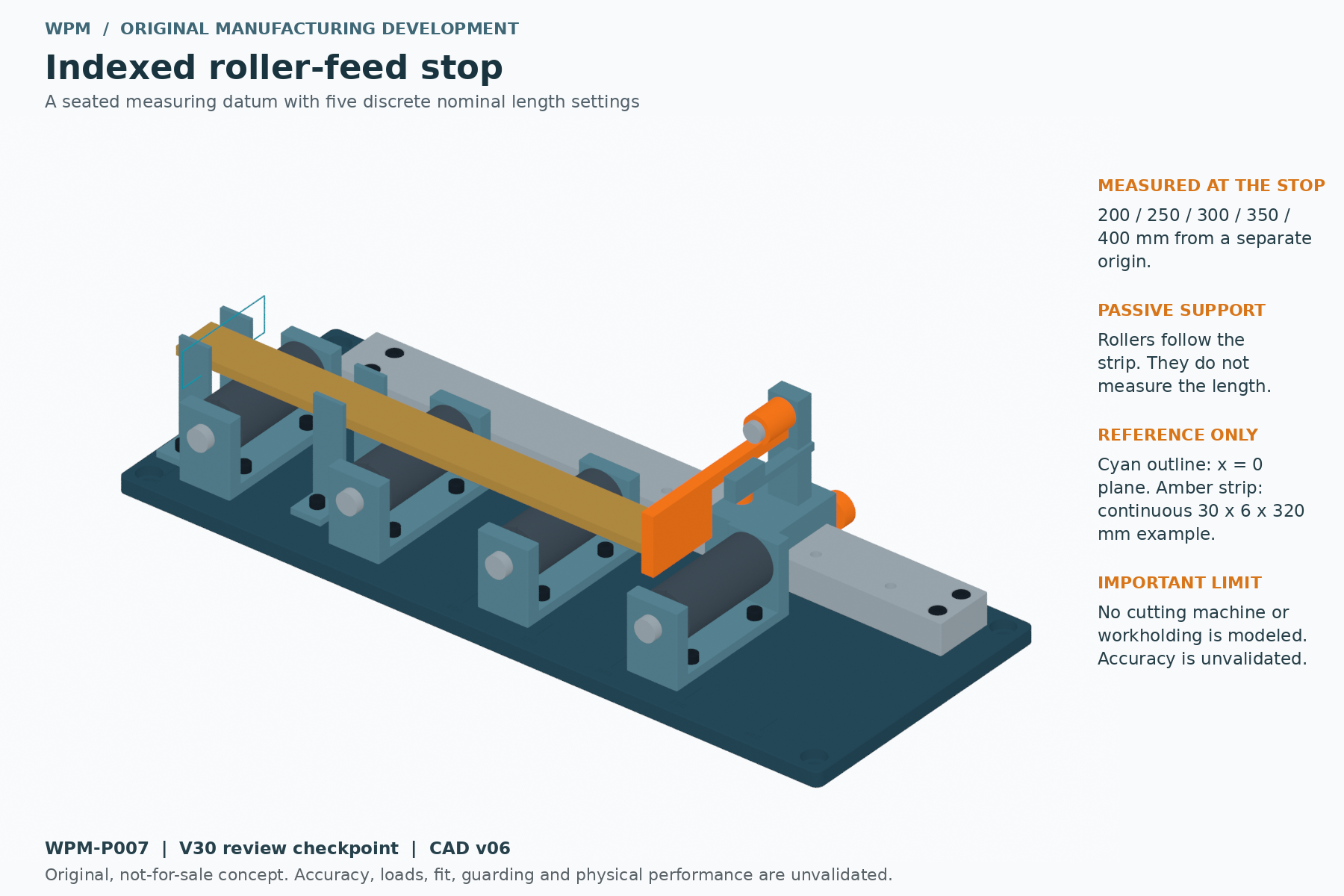
Four passive rollers support manually advanced flat strip against a seated stop, exploring a simple bench arrangement for repeat-positioning tasks.
Nominal CAD only. No cutting machine, workholding or machine fit is modeled. The raised blade is manually held; there is no hold-open detent. Pin clearance and transverse clamping do not establish accuracy or repeatability. No tested capacity, safety or commercial readiness is claimed.
How the concept works
The stop carriage indexes along a rail, and its blade presents a seated measuring datum. The demonstration changes from a nominal 250 mm setting to 300 mm. The cyan outline identifies the separate reference origin; the amber strip is a hypothetical workpiece. A real setup would require an independently established bench datum, suitable workholding and application-specific validation.
The 40.5-second function study shows manual strip advancement, the held-blade and pin sequence, repositioning and reclamping. Hands and tools are omitted. The side clamp acts transversely; it does not remove all longitudinal freedom or establish a precision rating.
Components and retention
Assembly study
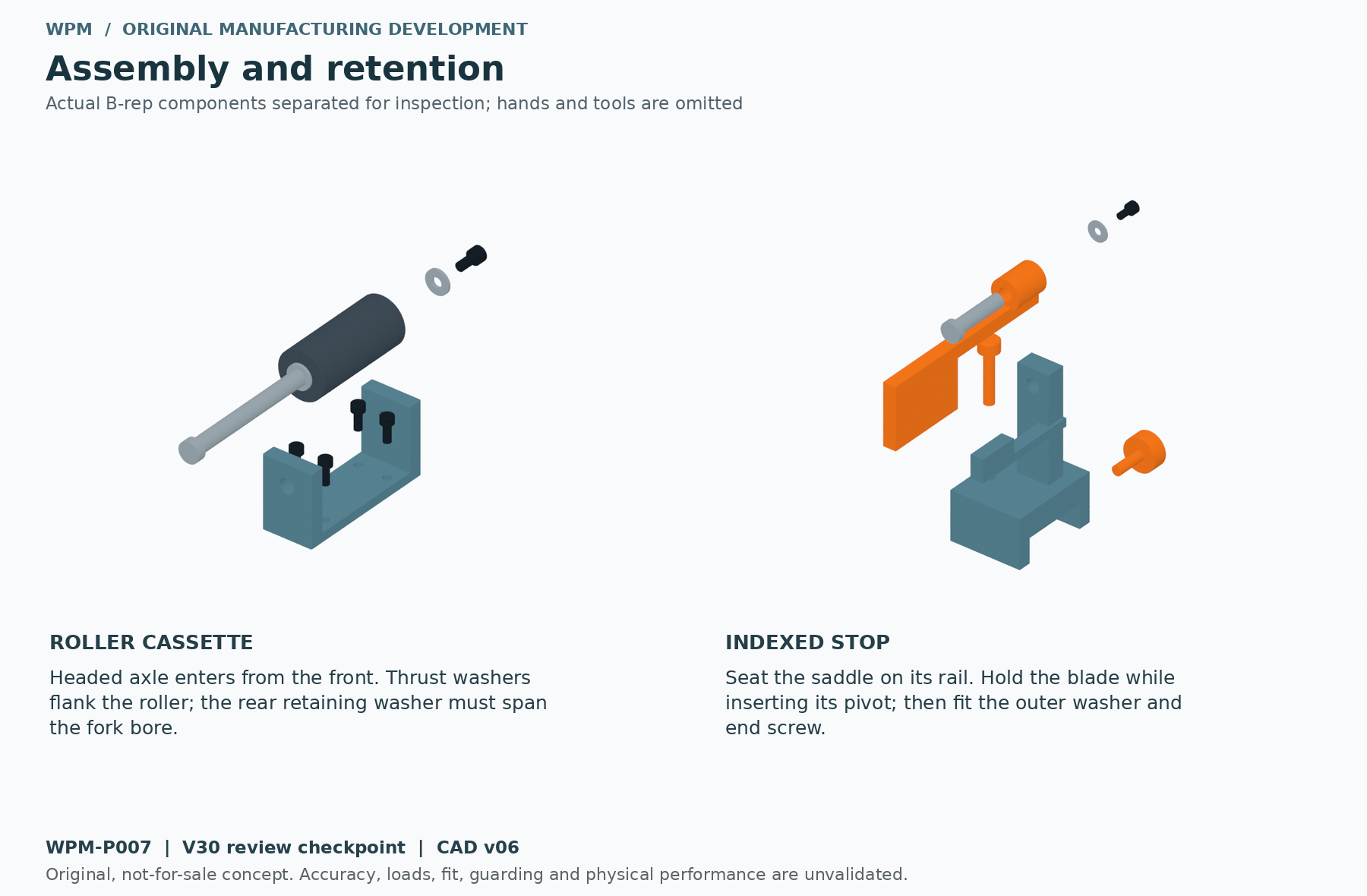
Approximately 1 minute 4 seconds: staged whole-part assembly explains the arrangement and retention. Unthreading, hand support, tool access, fits and assembly forces are simplified or omitted. This is not a released build instruction.
Disassembly study
Approximately 1 minute 2 seconds: the components separate in a nominal CAD sequence. Pause, seek or use fullscreen to inspect the labels. Physical handling and service trials remain open.
Roller service study
Approximately 41 seconds: the service illustration explores access to the roller assembly. It does not establish a safe or validated maintenance procedure. Actual tools, hand access, retention, wear and replacement fits still require development.
Sections through the source CAD
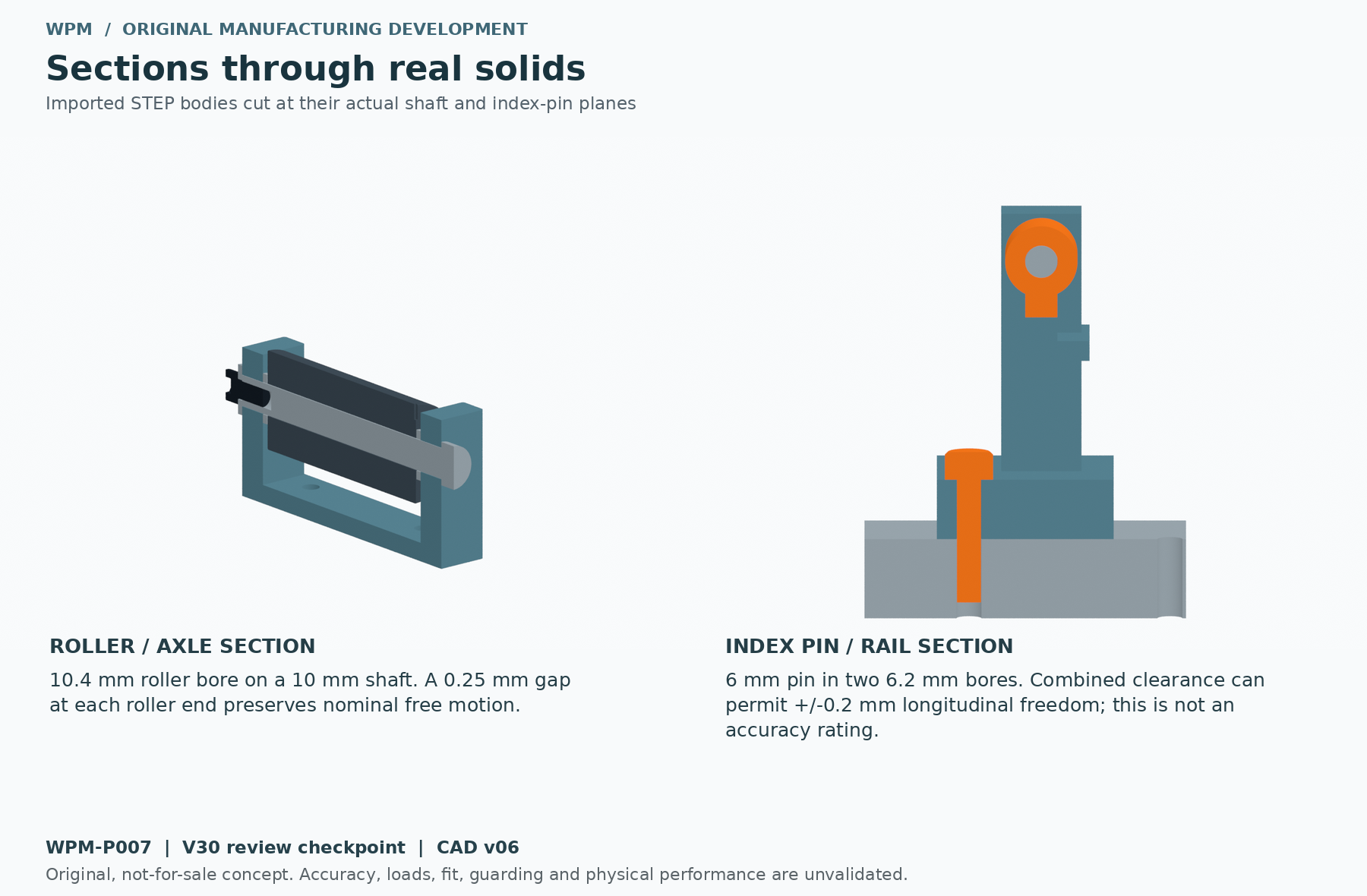
The roller section shows nominal free-motion clearance around the axle and at the roller ends. Combined pin-to-bore clearance can permit longitudinal freedom; transverse clamping is not an accuracy guarantee.
Manufacturing development ahead
Confirm materials, tolerances, threads, wear behavior, loads, friction, bench datum, hand access and machine integration for the intended application. Physical trials and suitable safeguarding are needed before relying on performance or service procedures.
WPM is a manufacturability and onshoring company, not an engineering firm. This original hypothetical study supports design-for-manufacture discussions and does not establish professional engineering approval or production readiness.
Study scope
Product-only nominal concept assembly, 63 solids. No cutting machine or workholding is modeled. Fits, loads, guarding, accuracy and repeatability remain unvalidated. The raised blade requires manual support; no hold-open detent is provided.
V30 identifies the review checkpoint. The actual CAD revision is v06 and the function presentation is S3. This is an original hypothetical study, not customer work.